The Biggest Polish Cities: An Overview
When you think of Poland, vibrant metropolises and never-sleeping cultural hubs probably don’t spring to mind. There is only one Polish city with a population over one million¹ – and yet, it’s precisely this modest scale that makes Polish cities so worth exploring, and so liveable. They are dynamic and full of things to do, just not in the exhausting, overwhelming way that megacities can be. They offer career and education opportunities and are great for city breaks too. Each one is unique, with its own character, history, and charm.
Have a look at this overview to find out which Polish city appeals to you most.
Warsaw
Population¹: 1,864,035
Location: East-central Poland, on the Vistula River
Nearest airports: Warsaw Chopin Airport (WAW), Warsaw Modlin Airport (WMI)
Key characteristics: Warsaw is the capital of Poland and home to the country’s most important political and financial institutions. It’s a city of contrasts – modern glass towers are situated not far from the carefully reconstructed historical districts, and a metropolitan lifestyle coexists with a rich cultural scene. Warsaw is considered the most expensive city in Poland when it comes to property prices², but it is also one of the cities with the highest earnings in the enterprise sector³. In 2025, the IMD Smart City Index ranked Warsaw in the top 30 smartest cities in the world⁴.
Top 5 tourist attractions in Warsaw: UNESCO Old Town, the Royal Route, the Palace of Culture and Science, Łazienki Park, and the POLIN Museum of the History of Polish Jews.
Fun fact: Fryderyk Chopin spent his childhood and youth in Warsaw, and the city honours his legacy in many ways. Visit the Chopin Museum, sit on benches that play his music at the touch of a button, or catch a live piano concert by the Chopin Monument in Łazienki Park. Every five years, Warsaw also hosts the prestigious International Chopin Piano Competition at the Warsaw Philharmonic.
Secret tip: If you’ve had your fill of museums and historical sights, take a break in one of Warsaw’s parks. What surprises many visitors is that some of the most beautiful green spaces are right in the city centre – you don’t have to go far to find them.
Check out our Easy Polish Warsaw Playlist to learn more about the capital of Poland.
Kraków
Population¹: 810,590
Location: Southern Poland, on the Vistula River
Nearest airport: John Paul II International Airport Kraków-Balice (KRK)
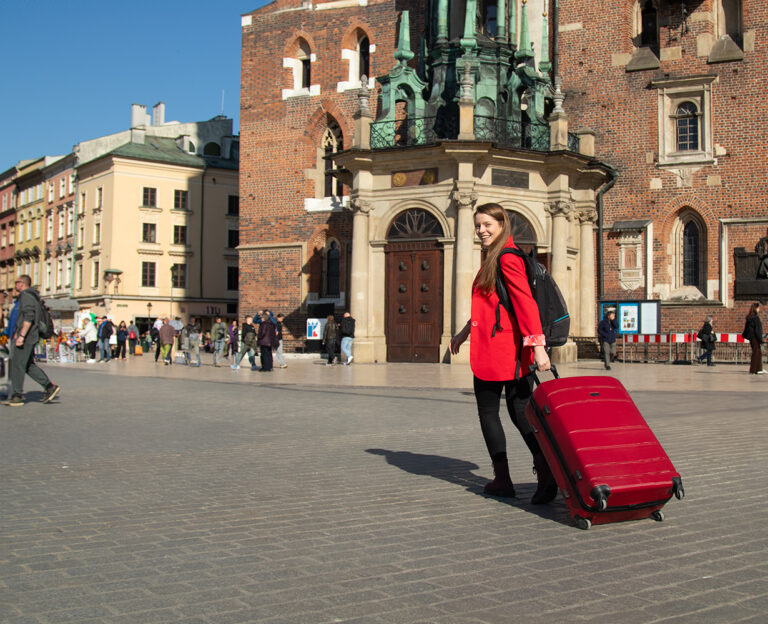
Key characteristics: Kraków was Poland’s capital for centuries and remains one of the country’s most important heritage centres – the historic cradle of much of Polish culture, art, and tradition. Its beauty makes it hugely popular with both foreign and domestic tourists. It is a city of art, culture, and stunning architecture, but it is also a thriving hub for the IT industry and is considered the city with the highest earnings in Poland in the enterprise sector³.
Top 5 tourist attractions in Kraków: the UNESCO Historic Centre (including St. Mary’s Basilica, the Cloth Hall and Poland’s oldest university), the National Museum, Wawel Royal Castle and Cathedral, the former Jewish district of Kazimierz, and Schindler’s Factory Museum.
Fun fact: In Kraków, you can see a statue that breathes fire. The Dragon of Wawel is a legendary creature, and its statue at the foot of Wawel Hill shoots real flames – a firm favourite with children.
Secret tip: Kraków is full of historic churches in a remarkable range of architectural styles. The most famous is St. Mary’s Basilica on the Main Square, but there is another gem not far away. Step inside the Basilica of St. Francis of Assisi, walk in a little, then turn around. The stained glass window behind you is truly breathtaking.
Have a look at our Easy Polish Kraków playlist to learn more.
Wrocław
Population¹: 672,545
Location: Southwestern Poland, on the Oder River
Nearest airport: Wrocław Nicolaus Copernicus Airport (WRO)
Key characteristics: Wrocław was a German city called Breslau for many years, and this heritage is still visible in the architecture and atmosphere – making it a fascinating cross-cultural experience. It is also one of Poland’s most beautiful cities, sometimes called the Venice of the North, thanks to its location on the Oder River, with its many islands and picturesque bridges. In 2025, it was ranked first among mid-sized European cities in fDi’s European Cities of the Future overall ranking⁵.
Top 5 tourist attractions in Wrocław: the Old Town Market Square, the UNESCO-listed Centennial Hall, the Racławice Panorama, Cathedral Island (Ostrów Tumski), and the Japanese Garden.
Fun fact: Wrocław – or rather Breslau – is the setting for an acclaimed crime novel series featuring detective Eberhard Mock, written by Polish author Marek Krajewski. Many of Krajewski’s novels have been translated into English, so if you enjoy literary tourism as much as the real thing, pick them up before your visit.
Secret tip: This is less of a secret and more of a must-know. As you explore Wrocław, keep an eye out for small dwarf statues scattered around the city. There are loads of them, each with its own character and story, and they’ve become something of a symbol of the city. Spotting them is an enjoyable activity for visitors of all ages.
Have a peek at a video we recorderd in Wrocław
Łódź
Population¹: 642,590
Location: Central Poland
Nearest airport: Łódź Władysław Reymont Airport, also known as Łódź Airport Central Poland (LCJ)
Key characteristics: In the past, Łódź was a highly industrial city specialising in textiles, and though the importance of industry has diminished, this heritage and vibe is still very much present. However, Łódź – long associated with bleakness and decline – has been steadily reinventing itself, an effort recognised by National Geographic Traveler, which included the city in its „Best of the World 2022” list⁶. The city is also home to one of the best film schools in Europe, whose graduates include legendary directors Andrzej Wajda and Krzysztof Kieślowski.
Top 5 tourist attractions in Łódź: Piotrkowska Street, Manufaktura, the Cinematography Museum, the Museum of the Textile Industry, and Herbst Palace and Museum.
Fun fact: Over the years, Łódź has collected a few memorable nicknames: HollyŁódź (a nod to its cinematic legacy), the Polish Manchester (reflecting its industrial past, immortalised in Władysław Reymont’s novel and Wajda’s famous film adaptation The Promised Land), and the City of Four Cultures – a reference to its multicultural history, when Polish, Russian, German, and Jewish communities lived side by side.
Secret tip: When you visit Piotrkowska Street, turn off into Pasaż Róży – a hidden passageway covered in tiny mirror fragments. On a sunny day, it’s dazzling.
Poznań
Population¹: 534,913
Location: West-central Poland, on the Warta River
Nearest airport: Poznań-Ławica Airport (POZ)
Key characteristics: Poznań has a lovely Old Town – more intimate in scale than Kraków or Gdańsk – as well as generous green spaces and even a lake within its borders. In the 2025 Numbeo Quality of Life ranking⁷, Poznań was rated the best city to live in Poland. This came as no surprise – Poznań has consistently ranked among the top cities in the Business Insider Polska quality of life rankings8.
Top 5 tourist attractions in Poznań: the Old Town with its Town Hall, Cytadela Park, Stary Browar, Cathedral Island (Ostrów Tumski), and the Croissant Museum.
Fun fact: Poznań is where three Polish mathematicians and cryptologists – Marian Rejewski, Henryk Zygalski, and Jerzy Różycki – first cracked the Enigma code, an achievement with enormous consequences for the outcome of the Second World War. The city’s Enigma Cipher Centre tells the full story and introduces visitors to the fascinating world of codes and ciphers. Definitely worth a visit.
Secret tip: If you have a sweet tooth, Poznań won’t disappoint. The local speciality is the St. Martin’s croissant – a flaky pastry filled with white poppy seed paste. Look out for ones with an official certificate of authenticity. And if sweet things aren’t your thing, try pyry z gzikiem – potatoes served with specially seasoned quark.
Gdańsk
Population¹: 489,160
Location: Northern Poland, at the mouth of the Vistula River, on the Baltic Sea
Nearest airport: Gdańsk Lech Wałęsa Airport (GDN)
Key characteristics: Gdańsk is a harbour city with a truly impressive Old Town. It is also a place of great historical importance as it was the birthplace of Solidarność (Solidarity), the trade union movement that played a pivotal role in bringing down Communism in Poland. The city is now an important logistics hub. It has beaches and, among the cities in this guide, the best air quality – noticeably better than in Kraków or many other southern towns, though still in the mid-range on a worldwide scale (see IQAir 2024 map showing PM2.5 concentrations by city9). In the 2025 Numbeo Quality of Life ranking⁷, Gdańsk was rated the second best city to live in Poland. Together with Gdynia and Sopot, Gdańsk forms the Tricity urban area – so if you’re visiting, it’s well worth exploring the other two as well.
Top 5 tourist attractions in Gdańsk: the Old Town with St. Mary’s Church and Długa Street, the Museum of the Second World War, the European Solidarity Centre, Oliwa Park, and Westerplatte.
Fun fact: In 2023, Gdańsk became the largest city in Poland by area, overtaking Warsaw – largely because the adjacent sea area is now included in the calculation.
Secret tip: Gdańsk is at its most crowded in summer, thanks to its beaches and seaside location. But the city is worth a visit at any time of year – and outside of peak season, it’s noticeably quieter.
Author: Elżbieta Pawlas-Matuszek
Sources:
¹ https://stat.gov.pl/obszary-tematyczne/ludnosc/ludnosc/ludnosc-stan-i-struktura-ludnosci-oraz-ruch-naturalny-w-przekroju-terytorialnym-w-2025-r-stan-w-dniu-30-czerwca,6,39.html, accessed March 2026, the article refers to data from 30 June, 2025
² https://rynekpierwotny.pl/ceny/mieszkania/, accessed March 2026, the article refers to data from February 2026
³ https://statystykamiast.stat.gov.pl/, accessed March 2026, the article refers to data from January 2026
⁴ https://www.imd.org/smart-city-observatory/home/rankings/, the article refers to the 2025 edition, accessed March 2026
⁵ https://ecrof25.fdiintelligence.com/, the article refers to the 2025 edition (fDi’s European Cities of the Future 2025 Ranking), accessed March 2026
⁶ https://www.nationalgeographic.com/travel/article/best-of-the-world-2022, accessed March 2026
⁷ https://www.numbeo.com/quality-of-life/rankings.jsp?title=2025, the article refers to the 2025 edition, accessed March 2026
8 https://businessinsider.com.pl/, the article refers to multiple rankings published over the years, accessed March 2026
9 https://www.iqair.com/world-air-quality-report, the article refers to the 2024 report, accessed March 2026